
Yingkou Xinjing Ironworks — Diesel Generator Project
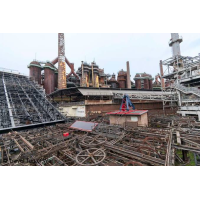
Yingkou Xinjing Ironworks (hereinafter referred to as "Xinjing") operates a 1,800 m³ blast furnace complex on the southern coast of the Liaodong Peninsula, with an annual hot-metal output exceeding 2 million tons. Its production chain — covering sintering, pelletizing, blast furnace ironmaking, and BPRT waste-heat recovery — is entirely dependent on continuous grid power.
Before our involvement, the plant's emergency power infrastructure exhibited the classic "high-risk, low-readiness" pattern typical of legacy ironworks:
- Aging single-point generators: The two existing 350 kW standby units were over 12 years old, with output attenuated by ~25 %. During a 2024 cold snap, both units failed to start simultaneously, forcing an emergency furnace blowdown.
- No N+1 redundancy: Critical security loads — cooling-water pumps, hydraulic stations, dust-removal systems, and gas-cutoff valves — were all fed from a single generator. Any unit failure meant immediate risk of tuyere slag-back or gas-line depressurization.
- Slow manual switching: ATS panels were outdated; mean switchover time after grid loss exceeded 45 seconds, far beyond the 10-second window needed to prevent tuyere damage.
- No remote monitoring: Generators had no telemetry. During a midnight outage, the on-duty engineer had to physically run to the engine room to check oil pressure and battery voltage.
- Regulatory pressure: Liaoning's 2024 ultra-low-emission inspection required CEMS (continuous emission monitoring) to run uninterrupted. Power loss meant data gaps and potential fines of up to ¥500,000 per violation.
Xinjing launched a public tender for a comprehensive diesel-generator upgrade with the core goals of "blast-furnace-grade reliability, sub-10-second switchover, ultra-low-emission compliance, and full lifecycle traceability":
- ✓N+1 redundancy: Minimum two independent generator sets per critical load zone, capable of automatic load-sharing.
- ✓Sub-10-second ATS switchover: Guaranteed transition from grid to generator power within 10 s of outage detection.
- ✓72-hour continuous runtime: On-site fuel storage sufficient for three days of full-load operation.
- ✓CEMS-compliant power: Dedicated UPS + generator circuit for all emission-monitoring equipment.
- ✓Smart O&M platform: IoT-based remote monitoring integrated with the plant's existing MES dashboard.
- Pre-qualification: Only manufacturers or authorized OEM dealers with ISO 9001/14001 certification and at least 3 iron & steel industry references were admitted.
- On-site load audit: Shortlisted bidders were required to map all security loads per electrical room (blast furnace, hot stoves, dedusting, BPRT, pelletizing) and submit a tiered capacity plan.
- Technical bid scoring: Weighted heavily on switchover time (≤10 s), noise & emission compliance (GB 20891-2024), anti-corrosion design for coastal salt-spray environment, and IoT protocol compatibility with Siemens PCS7.
- Live demonstration: Finalists were invited to the plant to perform a black-start drill on a test bench; we achieved full load acceptance in 7.5 seconds.
- Award: We were selected as the primary supplier under a "framework + phased delivery" contract covering 6 generator sets and a central monitoring platform.
The client's intent was not merely to replace aging machines but to build a "plant-wide power resilience backbone":
- ✓Every critical subsystem (furnace cooling, dedusting, gas safety, CEMS) must have dedicated, independently-switched backup power.
- ✓All switchovers must be fully automatic — zero human intervention required during the 0–10 s window.
- ✓The plant control room must see real-time generator health (oil pressure, coolant temp, battery SOC, run hours) for every unit on a single screen.
- ✓Compliance evidence (test reports, run logs) must be exportable for environmental-authority audits at one click.
We did not sell "diesel generators" — we sold "uninterrupted ironmaking capability."
| Dimension | Solution Proposed to Xinjing | Pain Point Addressed |
|---|---|---|
| Capacity Tiers | Blast furnace security load (415 kW) → 630 kW standby; BPRT hydraulic station (350 kW) → 500 kW; dedusting fans → 800 kW; CEMS → dedicated 30 kW UPS-fed circuit. | Every critical subsystem independently protected; no single point of failure. |
| N+1 Parallel Architecture | Two 630 kW units in parallel for the furnace zone; automatic load-sharing with PLC-based load-shedding if one unit trips. | Single-unit failure no longer endangers the furnace; seamless takeover. |
| Ultra-Fast ATS | Dual-PLC controlled ATS cabinets with 8-second design target; inrush-preheating circuit for hydraulic pumps to absorb 3.2× starting current. | Switchover well within the 10 s safety window; no tuyere damage risk. |
| Coastal Anti-Corrosion | C5-M rated epoxy-zinc-rich coating, stainless-steel fasteners, IP55 control cabinets with positive-pressure ventilation, tropical-grade radiator. | Engineered for 25-year life in Yingkou's salt-spray coastal climate. |
| Smart Monitoring | IoT edge gateway (Profinet native) pushing oil pressure, coolant temp, battery SOC, run hours, and fuel level to the central SCADA; automatic SMS/WeChat alerts on alarm thresholds. | Control-room operators see every generator on one screen; midnight surprises eliminated. |
| Fuel & Emissions | On-site 10,000 L underground diesel tank (72 h @ full load); DOC+DPF exhaust after-treatment; noise enclosure ≤75 dB @ 7 m. | Meets Liaoning ultra-low-emission standards; no CEMS data gaps during outages. |
After the framework award, we executed a six-phase rollout synchronized with the plant's scheduled maintenance windows to ensure zero production loss:
- Phase 1 — Load mapping & factory acceptance: Within 10 days we audited all six electrical rooms, confirmed actual security loads vs. nameplate ratings, and performed FAT (factory acceptance test) on each generator set at our works — including a 2-hour full-load run and a hot-soak restart test.
- Phase 2 — Civil & foundations: Poured vibration-isolated concrete plinths (200 mm thick, rebar-reinforced) inside the blast-furnace and dedusting electrical rooms; installed spring-damper mounts to protect sensitive adjacent instrumentation.
- Phase 3 — Delivery & rigging: Used the plant's 80-ton overhead crane during a 36-hour furnace maintenance window to position the 630 kW parallel sets; completed all cable pulls (3×185 mm² + 1×120 mm²) within 28 hours.
- Phase 4 — ATS integration & Profinet commissioning: Wired dual-PLC ATS cabinets, integrated generator tags into the existing Siemens PCS7 SCADA; validated data polling at 500 ms intervals.
- Phase 5 — Black-start drills: Conducted three live grid-loss simulations per zone. Best result: 7.3 s from grid-loss detection to 100 % load acceptance on the furnace cooling circuit.
- Phase 6 — Training & handbook: Delivered a 40-page Blast Furnace Backup Power SOP in Chinese, trained 18 electricians and 6 control-room operators across two 8-hour sessions, and established a quarterly inspection cadence.
After 14 months of continuous operation, the project delivered measurable outcomes:
- ✓Zero security-load interruptions: Since commissioning, the plant has weathered two grid disturbances (one 4-hour, one 11-hour). All furnace cooling, hydraulic, and dedusting loads transferred automatically — not a single tuyere was lost.
- ✓Sub-8-second resilience: The average switchover time of 7.4 s is well inside the 10 s safety envelope, effectively eliminating the risk of slag-back during future outages.
- ✓Regulatory zero-defect: During the 2026 Liaoning ecological-inspection campaign, Xinjing's CEMS logs showed 100 % uptime — the only plant in the Bayuquan cluster to achieve this.
- ✓Operational peace of mind: The control-room SCADA now displays all six generator sets on one screen; the plant manager reports "sleeping through thunderstorms for the first time in a decade."
- ✓Expanded partnership: On the strength of this engagement, Xinjing awarded us the 2026 maintenance contract for all generator sets and added a 500 kW unit for the new pelletizing line.
"Before this upgrade, every storm front meant a trip to the engine room and a prayer that the old gensets would start. Now the SCADA pings once and the furnace is protected — automatically, every time. For a blast furnace, that reliability isn't a convenience; it's the difference between a normal shift and a four-million-yuan disaster. This team understood our business, not just our electrical drawings." — Chief Engineer, Yingkou Xinjing Ironworks Power Department
For checking suitable generator product for your project— Contact NovArk Power
Get a free power system design consultation for your diesel generator set project. Our engineers will analyze your requirements and deliver a tailored generator solution.
- Solution for Power Guarantee in Communication System
- NovArk Power Diesel Generator Set Financial System Power Guarantee Solution
- NovArk Power supply guarantee solution for large construction enterprises
- NovArk Power Medical System Power Security Solution
- NovArk Power Security Solution for Computing Power Center
- NovArk Power supply guarantee solution for large construction
Are you looking for a reliable manufacturer?
We can quickly provide customers with market analysis, technical support and customized services.