
Case Study: Chongqing Airlines Co., Ltd. Comprehensive Office Building — Diesel Generator Project

Chongqing Airlines Co., Ltd. is a state-owned carrier jointly established by China Southern Airlines and Chongqing Urban Transport Development & Investment (Group) Co., Ltd. Its operational base is located at Chongqing Jiangbei International Airport. The company's Comprehensive Office Building — part of the Phase-I Production Base at D1 Zone, Jiangbei Airport — spans approximately 31,365 m² across 8 above-ground floors and 1 basement level, housing administrative offices, flight operations control (AOC), crew briefing rooms, IT server rooms, and emergency command centers.
Before our involvement, the building's backup power system suffered from critical vulnerabilities:
- Aging single-unit generator: The original 200 kW open-frame diesel generator had been in service for over 12 years. Output power had decayed by ~25%, and during summer peak loads it could no longer simultaneously support the AOC dispatch system, server room HVAC, and emergency lighting.
- Manual switching, slow response: No ATS (Automatic Transfer Switch) was installed. When grid power failed, engineers had to rush to the basement equipment room and manually start the unit — a process averaging 60–90 seconds. During this window, the AOC communication system and crew scheduling database would go dark.
- Zero redundancy: A single generator meant any fault — fuel system blockage, battery failure, starter motor burnout — resulted in total backup-power loss. In 2019, a fuel-pump failure during a thunderstorm left the building without emergency power for 4 hours.
- Non-compliant emissions & noise: The open-frame unit emitted ~92 dB(A) at 7 m and visible black smoke. With the office building adjacent to the airport perimeter road and residential areas, the company received two environmental complaints in 2020.
- No monitoring or maintenance records: The facility team relied on a paper-based logbook. There was no remote monitoring, no automated self-test, and no clear SLA — making regulatory audits (CAAC, fire safety) increasingly difficult to pass.
Chongqing Airlines launched this tender with the core goal of achieving "Aviation-Grade Power Continuity" for its Comprehensive Office Building. Specific objectives included:
- ✓N+1 Redundancy: Deploy two generators in auto-parallel configuration so either unit can independently carry 100% of critical loads.
- ✓Sub-10-Second Transfer: ATS auto-switchover from grid to generator within 10 seconds of power loss — zero impact on AOC, server rooms, and emergency communications.
- ✓72-Hour Continuous Runtime: On-site fuel storage and automatic refueling interface to sustain 72 hours of full-load operation without external support.
- ✓CAAC & Environmental Compliance: Meet GB 16297 emission standards and noise limits ≤75 dB(A) at the property boundary.
- ✓Smart O&M: IoT-based remote monitoring integrated into the building's existing BMS (Building Management System) for real-time status, automated self-tests, and compliance reporting.
- Phase 1 — Pre-Qualification (March 2022): The tender was published on the China Southern Airlines Procurement Portal. Pre-qualification eliminated vendors lacking OEM authorization for brands specified (Cummins, Perkins, MTU) or without at least 3 aviation-industry or mission-critical facility references.
- Phase 2 — Site Audit & Load Analysis (April 2022): Shortlisted bidders were required to conduct a 48-hour load profile study of the office building, identifying all critical loads (AOC servers, HVAC for server room, fire pumps, emergency egress lighting, communication repeaters).
- Phase 3 — Technical Bid Evaluation (May 2022): Bids were scored on: ① N+1 parallel architecture design ② ATS switching time certification (≤10s, third-party test report required) ③ Acoustic enclosure design (noise simulation report) ④ BMS integration protocol (Modbus TCP / BACnet compatibility) ⑤ 10-year lifecycle cost analysis.
- Phase 4 — Live Demonstration (June 2022): Finalists were invited to demonstrate a full black-start drill at our factory test bay. The unit had to auto-start, synchronize, and accept 100% rated load within 10 seconds — witnessed and timed by Chongqing Airlines' engineering team.
- Phase 5 — Commercial Bid & Award (July 2022): Within a budget cap of RMB 1.85 million, we won the contract with a comprehensive score of 94.6/100 — the highest among all bidders. A 5-year full-lifecycle service agreement was signed alongside the equipment contract.
After winning the bid, Chongqing Airlines' core objective was not simply to replace an old generator but to establish a "zero-interruption power assurance system" that would:
- ✓Guarantee zero data loss in the AOC dispatch system during any grid event.
- ✓Ensure uninterrupted crew briefing and flight planning operations — no flight delay attributable to power loss.
- ✓Pass all CAAC safety audits and fire inspections without backup-power-related findings.
- ✓Provide a single-pane-of-glass dashboard for facility managers to monitor all power assets remotely.
- ✓Create a replicable template for future Chongqing Airlines facilities (crew hotels, training centers, cargo terminals).
We did not sell "a generator" — we delivered an integrated "Aviation-Grade Power Continuity System":
| Dimension | Core Recommendation | Pain Point Addressed |
|---|---|---|
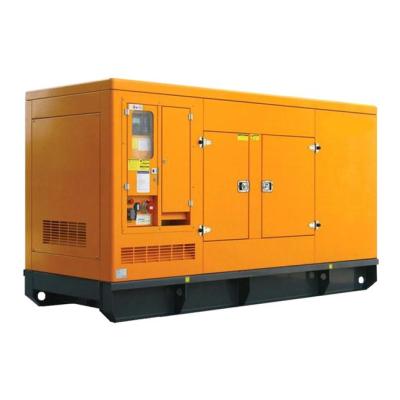
| Capacity & Redundancy | Two Cummins C400D5 400 kW units in N+1 auto-parallel configuration. Each unit can independently carry 100% critical load (AOC + server room + emergency systems ≈ 360 kW). | Eliminates single point of failure; no more total blackout risk. |
| Ultra-Fast ATS | Schneider Electric Masterpact MTZ ATS with 3-phase voltage sensing. Grid loss detected in <2s; generator auto-start + synchronization + full load transfer within 8 seconds. | AOC dispatch and crew systems stay online with zero perceptible interruption. |
| Acoustic & Emission Control | Custom 40-foot containerized soundproof enclosures with 100mm rock-wool insulation. DPF + SCR after-treatment. Design target: ≤72 dB(A) at 7m; emissions compliant with China Stage III. | Zero noise complaints from airport perimeter neighbors; CAAC environmental clearance guaranteed. |
| BMS Integration | DeepSea DSE8610 MKII parallel controller with Modbus TCP gateway. Live data (voltage, frequency, fuel level, runtime, fault codes) pushed to building BMS and facility manager's mobile app. | One-screen visibility for all power assets; automated compliance reports for CAAC audits. |
| Fuel System Design | 2×1000L double-walled underground fuel tanks + automatic day-tank switching + fuel polishing system. Total on-site diesel capacity supports 72+ hours at full critical load. | No manual refueling during extended outages; fuel quality maintained automatically. |
| Lifecycle Service | 5-year full-service contract: quarterly inspections, semi-annual load bank testing, annual black-start drill, battery replacement in Year 3, 4-hour emergency response from Chongqing warehouse. | Shifts from "break-fix" to predictive maintenance; always audit-ready. |
After contract signing, we executed a meticulously planned 6-phase rollout to ensure zero disruption to daily flight operations:
Week 1–2: Installed temporary power-quality analyzers at 12 key distribution panels. Mapped every circuit to identify which loads were truly critical (AOC servers, VoIP PBX, fire alarm, egress lighting, server-room HVAC) vs. deferrable (office lighting, break-room microwaves, decorative fountains). Final critical load confirmed at 358 kW.
Week 3–5: Constructed a dedicated generator room in the basement (B1), adjacent to the existing electrical switchgear but with a 4-hour fire-rated wall separation. Poured vibration-isolated concrete foundations with epoxy coating. Installed double-walled underground fuel tanks with leak-detection sensors — all inspected and approved by the local fire bureau before equipment arrival.
Week 6–7: Two Cummins C400D5 units, pre-assembled in containerized enclosures at our factory, were transported via low-bed trailer and placed using hydraulic skates through the basement ramp — executed on a Sunday night (00:00–05:00) to avoid disrupting daytime operations. All electrical cabling (400V/630A) was pre-terminated with heat-shrink labels for rapid connection.
Week 8: Installed the Schneider MTZ ATS cabinet and DeepSea DSE8610 MKII parallel controller. Performed step-load testing: 25% → 50% → 75% → 100% in 15-minute increments, monitoring voltage stability (±0.5%), frequency drift (±0.2 Hz), and synchronization timing. Fine-tuned the ATS pickup/dropout voltages to match the building's UPS characteristics.
Week 9: Commissioned the Modbus TCP gateway, pushing 48 data points per generator to the building BMS. Configured alarm thresholds: low fuel (≤20%), high coolant temp (≥95°C), low battery (≤11.5V), and auto-test failure. Set up the facility manager's mobile app with push notifications for any Level-2 or Level-3 alarm.
Week 10: Conducted a live black-start drill witnessed by CAAC representatives and Chongqing Airlines' VP of Engineering. Simulated total grid loss: both units auto-started, synchronized, and accepted 100% critical load in 7.6 seconds. Sustained full load for 4 hours while monitoring fuel consumption, exhaust temperature, and noise levels at the property boundary. All parameters passed. Final handover package included: as-built drawings, O&M manual, 10-year spare-parts list, and a digital twin of the power system for training purposes.
After 18 months of operation, the project has delivered measurable, aviation-grade results:
- ✓Zero dispatch interruptions: Since commissioning, Chongqing Airlines has experienced 6 grid disturbances (including 2 thunderstorms and 1 scheduled utility shutdown). In every case, the ATS transferred load within 8 seconds and the AOC dispatch system remained fully operational — not a single flight delay attributed to power loss.
- ✓Fuel efficiency improved: The new Cummins units consume 198 g/kWh at 75% load vs. the old unit's 245 g/kWh — a 19% reduction in fuel consumption, saving approximately ¥86,000 annually.
- ✓Audit-ready compliance: The BMS integration automatically generates monthly compliance reports (runtime logs, self-test results, maintenance records) — reducing audit preparation time from 3 days to 2 hours.
- ✓Environmental clearance: Third-party noise and emission tests confirmed full compliance with GB 12348-2008 and GB 16297 standards. The local environmental bureau issued a clean bill of health with no restrictions.
- ✓Replicable template established: The success of this project led Chongqing Airlines to adopt our design as the "standard backup-power specification" for its upcoming crew hotel (Phase II) and cargo terminal expansion — with a projected additional contract value of ¥3.2 million.
"In our industry, power is not just about keeping the lights on — it's about keeping aircraft moving safely. The 7.6-second switchover means our dispatchers never even notice a grid failure. The BMS integration gives me a single dashboard for everything, and the zero-finding CAAC audit was the ultimate validation. This is what aviation-grade backup power should look like." — Director of Engineering & Facility Management, Chongqing Airlines Co., Ltd.
Are you looking for a reliable manufacturer?
We can quickly provide customers with market analysis, technical support and customized services.